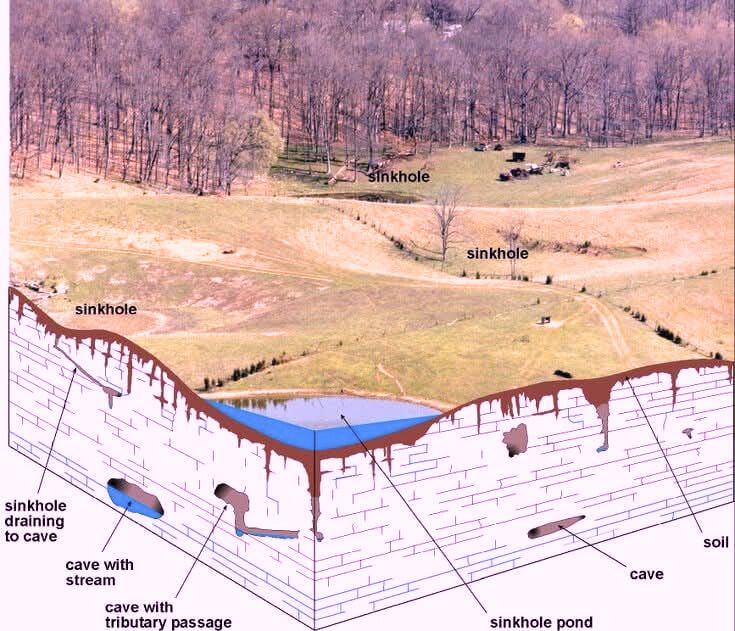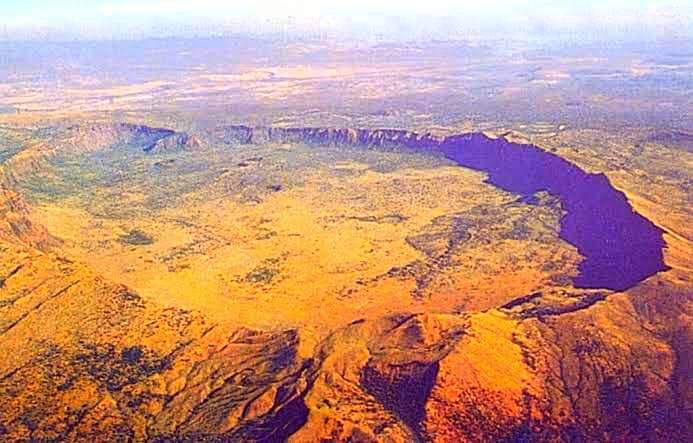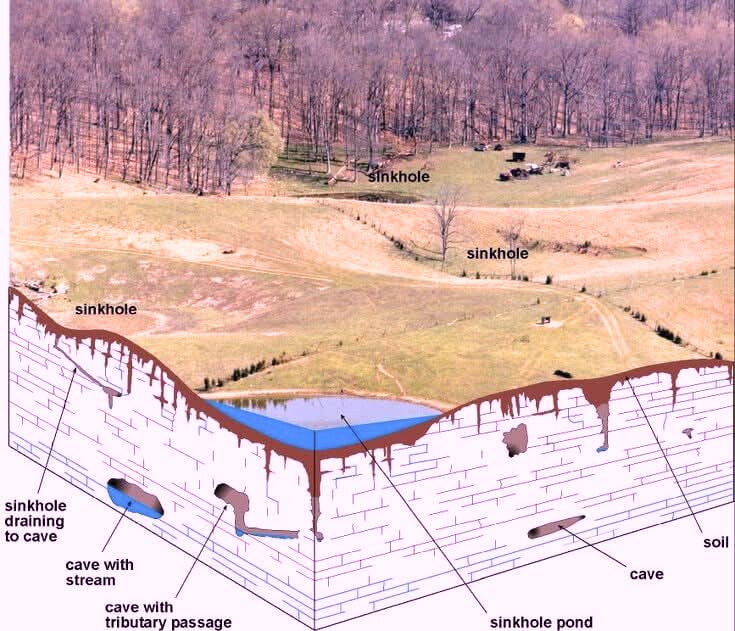
Sinkholes are natural depressions or holes that form in the Earth’s surface due to the dissolution of soluble rocks such as limestone, dolomite, or gypsum. They are a key feature of karst topography, which develops in regions where groundwater dissolves bedrock, creating underground voids, caves, and drainage systems. When the roof of an underground cavity collapses or subsides, a sinkhole appears at the surface.
FORMATION PROCESS OF SINKHOLES
1. CHEMICAL WEATHERING:
Rainwater absorbs carbon dioxide from the atmosphere and soil, forming weak carbonic acid.
This acidic water percolates through the soil and dissolves the underlying limestone or other carbonate rocks.
2. CAVITY DEVELOPMENT:
Over time, underground cavities and channels enlarge, creating subsurface voids and cave systems.
3. COLLAPSE OR SUBSIDENCE:
When the roof of a cave becomes unstable, it may collapse, forming a sinkhole at the surface.
In some cases, gradual downward movement (subsidence) forms bowl-shaped depressions.
TYPES OF SINKHOLES
1. SOLUTION SINKHOLES:
Form where soluble rock is exposed at the surface and is gradually dissolved by rainfall and runoff.
2. COVER-SUBSIDENCE SINKHOLES:
Develop where permeable soil slowly settles into voids beneath it.
3. COVER-COLLAPSE SINKHOLES:
Occur suddenly when the roof of an underground cavity collapses, creating a steep-sided hole.
ASSOCIATED FEATURES
• SINKHOLE POND: Forms when a sinkhole traps surface water.
• CAVE SYSTEMS: Underground passages and chambers formed by dissolution.
• CAVE WITH STREAM: Indicates active subsurface drainage.
• SINKHOLE DRAINING TO CAVE: Demonstrates the direct connection between surface runoff and groundwater flow in karst terrain.
GEOLOGICAL SIGNIFICANCE
• Indicate regions of active chemical weathering and groundwater movement.
• Can impact human activities — causing land subsidence, property damage, and groundwater contamination.
• Help geologists understand subsurface hydrology and rock dissolution processes.