INTRODUCTION
Aplite is an intrusive igneous rock that represents one of the final products of magmatic crystallization.
It is a fine-grained, light-colored rock mainly composed of quartz and alkali feldspar.
Aplites typically occur as small dykes, veins, or thin sheets associated with granitic intrusions.
They are the ultimate expression of residual magmatic fluids that have undergone extreme differentiation and are rich in silica and alkalis.
Because of their fine texture and uniform mineral composition, aplites are important in understanding late-stage magmatic processes, crystallization mechanisms, and hydrothermal activity in granitic environments.
DEFINITION AND GENERAL CHARACTERISTICS
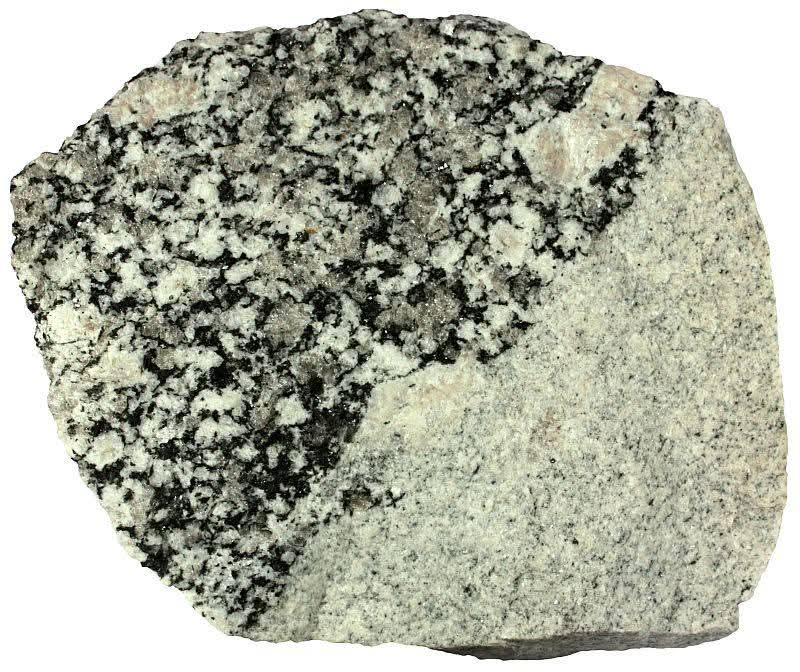
An aplite is defined as a fine-grained, equigranular igneous rock of granitic composition.
It is commonly white, grey, or pinkish in color and typically has a sugary or saccharoidal texture.
Aplites crystallize from the last portions of magma, known as the residual melt, after the formation of the main granite body.
The rapid cooling of this residual magma results in a fine-grained texture, unlike the coarse grains of granite.
Mineralogically, aplites contain quartz and alkali feldspar, often in roughly equal proportions, with minor amounts of plagioclase, muscovite, and biotite.
OCCURRENCE AND FIELD RELATIONSHIPS
Aplites are most commonly found in association with granitic and granodioritic plutons.
They occur as thin dykes or veins cutting through or bordering coarse-grained granitic rocks, pegmatites, or metamorphic host rocks.
In many cases, aplite veins fill fractures or joints within the granite, forming networks or irregular sheets.
Aplite-pegmatite associations are frequent, where pegmatites represent the most volatile-rich portion and aplites represent the more silica-rich but volatile-poor residue.
This association reveals the internal evolution of the magmatic system from coarse to fine crystallization.
PETROGRAPHY AND MINERALOGICAL COMPOSITION
Aplite is holocrystalline and equigranular, with an average grain size of less than 1 mm.
Under the microscope, it displays interlocking crystals of quartz and alkali feldspar forming a mosaic-like texture.
Quartz appears as anhedral grains showing undulatory extinction, while feldspars are usually orthoclase or microcline with occasional perthitic intergrowths.
Plagioclase, if present, is typically albite or oligoclase.
Accessory minerals may include muscovite, biotite, tourmaline, apatite, zircon, and iron oxides.
The mineralogical simplicity of aplite makes it an excellent example for studying the final stages of magmatic differentiation.
TEXTURAL FEATURES
The most characteristic texture of aplite is its fine-grained, equigranular mosaic of quartz and feldspar.
The absence of large phenocrysts or significant mineral zoning indicates rapid and uniform crystallization from a highly evolved melt.
In some cases, graphic intergrowths of quartz and feldspar may occur, though this is more common in granophyres and pegmatites.
The sharp contact between aplite and its host rock also indicates a distinct pulse of magma injection during the late magmatic stage.
CHEMICAL COMPOSITION
Chemically, aplites are silica-rich and rich in alkali elements (Na2O + K2O).
Their typical composition ranges from 70–80% SiO2, with low amounts of Fe, Mg, and Ca oxides.
The high silica content results from fractional crystallization and the removal of mafic minerals such as pyroxene and amphibole in earlier stages.
The chemical uniformity of aplites reflects the homogeneity of the residual melt from which they formed.
FORMATION AND GENESIS
The formation of aplite is tied to magmatic differentiation processes.
During the crystallization of a granitic magma, early-formed minerals (feldspars, biotite, amphibole) deplete the melt of certain components, leaving behind a residual liquid enriched in silica and volatile elements.
As crystallization progresses, this residual melt migrates into fractures or spaces within the parent rock and solidifies rapidly to form fine-grained aplite veins.
The low viscosity and high temperature of this melt allow it to penetrate narrow fissures, leading to the characteristic vein-like occurrence.
TECTONIC AND GEOLOGICAL SETTINGS
Aplites are found in both continental and orogenic settings, particularly in regions dominated by granitic magmatism.
They are common in collisional orogens, continental rift zones, and stable cratonic areas where granitic intrusions are present.
Aplite formation is often associated with late-stage magmatism following the emplacement of major plutons, reflecting the thermal and chemical evolution of crustal magmas.
RELATIONSHIP BETWEEN APLITE AND PEGMATITE
Aplite and pegmatite are complementary products of the same magmatic system.
While pegmatites represent the volatile-rich, slowly crystallized fraction of residual magma, aplites are formed from the volatile-poor, silica-rich fraction that cools quickly.
Both may occur together as alternating bands known as aplite-pegmatite dykes.
This association demonstrates the simultaneous segregation of volatile and crystalline components during the late crystallization of granitic magma.
GEOCHEMICAL AND ISOTOPIC STUDIES
Modern analytical techniques such as X-ray fluorescence (XRF), inductively coupled plasma mass spectrometry (ICP-MS), and electron microprobe analysis have provided detailed geochemical profiles of aplites.
These analyses reveal enrichment in silica, potassium, and trace elements such as lithium, rubidium, and tin.
Isotopic studies (Sr-Nd-Pb isotopes) indicate that aplites often derive from crustal sources or mixed mantle-crustal magmas.
These data help geologists understand crustal melting, magma differentiation, and the timing of pluton emplacement.
MODERN TECHNOLOGICAL APPROACHES IN APLITE STUDY
With modern geological technologies, the study of aplites has advanced significantly.
High-resolution petrographic imaging using scanning electron microscopes (SEM) and electron backscatter diffraction (EBSD) allows researchers to examine microtextures and crystal orientations.
Geochemical modeling software such as MELTS and Rhyolite-MELTS is used to simulate the crystallization path of residual granitic magmas and predict the conditions under which aplites form.
Remote sensing and GIS mapping techniques are also applied to locate aplite-bearing granitic complexes in inaccessible terrains.
Radiometric dating (U-Pb on zircon and monazite) provides accurate ages for aplite formation, contributing to regional geochronological frameworks.
ECONOMIC AND PRACTICAL IMPORTANCE
Although aplite itself is not an ore mineral source, it plays a crucial role in mineral exploration and industrial applications.
Aplite veins can serve as indicators of evolved magmatic systems that may host valuable pegmatite-associated minerals such as lithium, beryl, tourmaline, and rare earth elements.
In construction and industry, aplite is sometimes used as a raw material for the production of glass, ceramics, and abrasives due to its high silica and alkali content.
The uniform texture and color of aplite also make it suitable for decorative stone and architectural use.
FIELD IDENTIFICATION AND LABORATORY ANALYSIS
In the field, aplite is recognized by its fine-grained, light-colored, and sugary appearance.
It commonly occurs as narrow, cross-cutting veins within granite or along contacts with pegmatite.
Laboratory identification involves petrographic examination under the polarizing microscope to confirm the quartz-feldspar intergrowths.
Geochemical assays provide insight into its silica and alkali composition, confirming its granitic affinity.
Thin section studies further reveal the lack of mafic minerals and the characteristic equigranular texture.
GEOLOGICAL SIGNIFICANCE
Aplite holds significant value in understanding magmatic differentiation, crustal evolution, and the final crystallization phases of granitic magmas.
It provides direct evidence of the compositional evolution of silicate melts and the behavior of residual fluids.
Aplite-pegmatite systems also help in reconstructing magmatic histories and provide clues about temperature, pressure, and volatile conditions in the crust during late magmatism.
ENVIRONMENTAL AND ENGINEERING CONSIDERATIONS
From an engineering perspective, aplite’s fine-grained texture and hardness make it a durable material.
However, its brittleness requires caution in quarrying and cutting operations.
Environmentally, aplite outcrops may influence soil composition and local hydrology due to their mineral composition and low porosity.
CONCLUSION
Aplite represents one of the final crystallization products of granitic magmas, providing key insights into the chemical and physical evolution of the Earth’s crust.
Its simple mineralogy, fine texture, and close association with granitic and pegmatitic rocks make it an essential subject of study in igneous petrology.
Beyond academic research, aplite has practical significance in mineral exploration, construction materials, and industrial applications, reflecting its enduring importance in both scientific and practical geology.